YouTube Analytics
YouTube Retention Rate: What's Good, What's Bad, and How to Fix It
Most creators check their YouTube retention rate too early or compare it to the wrong benchmark. Here is what good retention actually looks like and how to improve it.
By Crescivo Team • July 11, 2026 • 10 min read
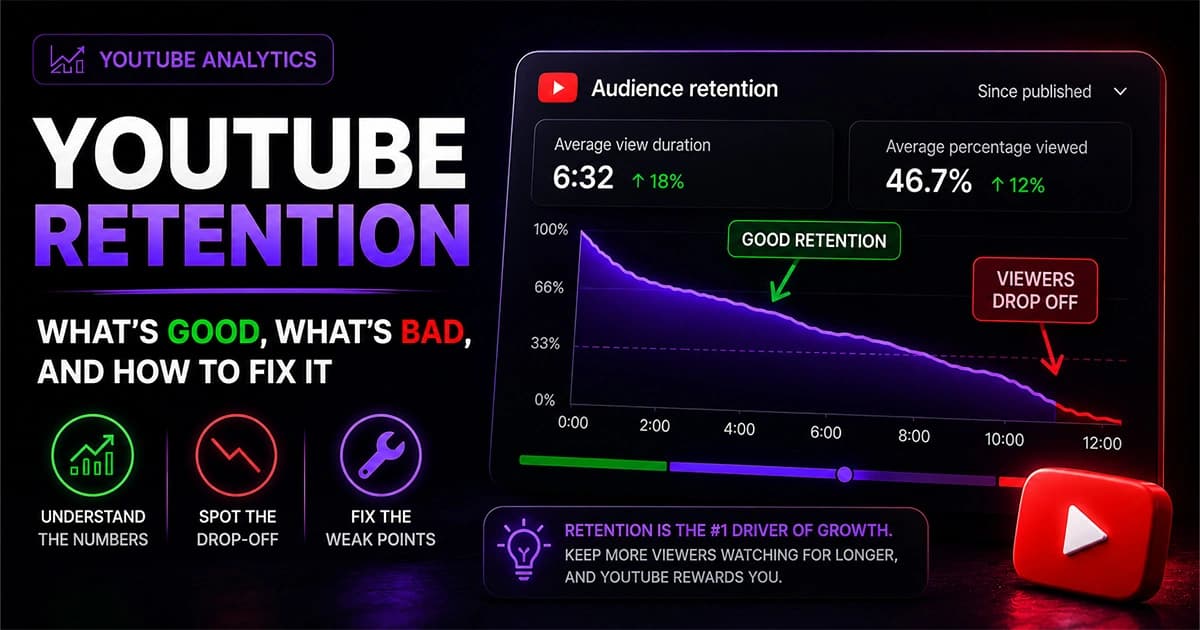
Table of contents
Retention is one of the most misread metrics on YouTube. A lot of creators check it too early, compare it to benchmarks that do not apply to their situation, and either panic over a number that is actually fine or miss a genuine problem because they are looking in the wrong place.
Here is what a good YouTube retention rate actually looks like, when to start paying attention to it, and how to fix the specific problems your graph is showing you.
Find Your Biggest YouTube Bottleneck
Most creators guess what to fix. Run the free Channel Bottleneck Calculator and discover the one metric holding back your growth.
Run Free AnalysisWhen to start looking at retention
Before drawing any conclusions from your retention data, check that you have enough views to make the numbers meaningful.
Retention on a video with 50 or 100 views fluctuates too much to be reliable. A handful of viewers dropping off early, or one person watching all the way through, can swing the average significantly. The number becomes trustworthy once it reflects a large enough sample.
A practical threshold: wait until a video has at least 10,000 impressions and a meaningful number of views before acting on what the retention graph shows. Before that point, the data is a rough indicator at best. Alongside that, aim to have a CTR of around 3% or above on your main traffic source. More impressions and stronger CTR mean more views, and more views mean the retention average is actually representative of how a broad audience responds to the video rather than a small, unrepresentative sample.
What a good YouTube retention rate looks like
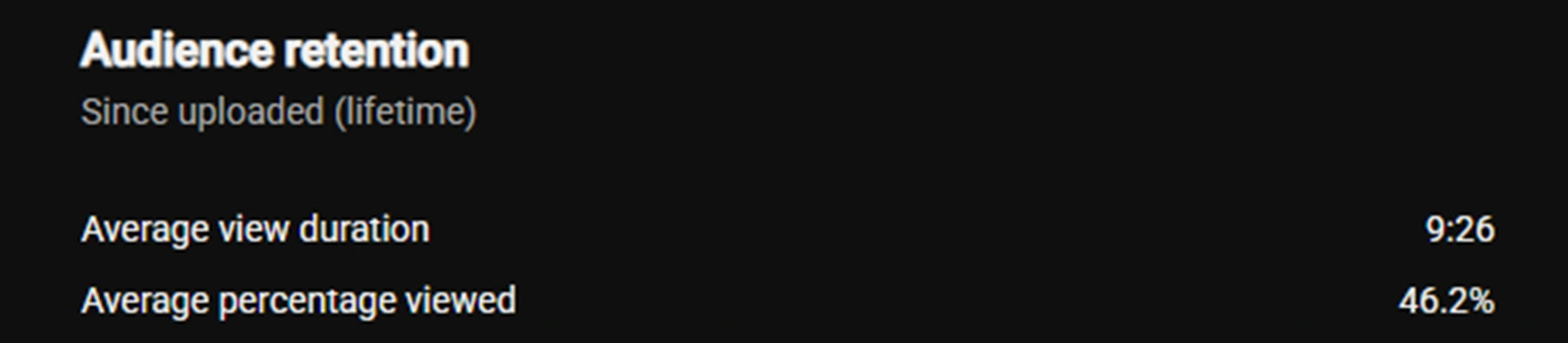
YouTube retention is measured in two ways: average view duration (the total number of minutes or seconds the average viewer watches) and average percentage viewed (what percentage of the video that represents).
Both matter, and neither tells the full story on its own. A 50% average percentage viewed on a 2-minute video is a different achievement from 50% on a 20-minute video.
The 30% benchmark
For most content, holding 30% average view duration is a practical starting point to work toward. On a 10-minute video, that means the average viewer is watching at least 3 minutes.
Three minutes is not a spectacular number, but it is enough for something important to happen. It gives you time for a proper introduction, time to deliver genuine value on the topic, time to earn the viewer's trust, and time to include a call to action that actually lands. Calls to action that appear before a viewer has spent any real time with you rarely convert because the trust has not been built yet. Getting to 3 minutes changes that.
For longer videos, the 30% target becomes harder to hit. On a 60-minute video, 30% is 18 minutes of average watch time, which is ambitious. For longer formats, a more realistic floor is aiming for at least 5 minutes of average view duration, which is enough to build meaningful trust and place a CTA effectively.
The higher you can push retention beyond these baselines, the better. There is no downside to a viewer watching more. More watch time means more trust, more opportunity to make an impression, and a stronger signal to YouTube that the video is delivering what it promised.
| Video length | Minimum AVD to target | Why it matters |
|---|---|---|
| 5–10 minutes | 30% (1.5–3 minutes) | Enough for trust and a CTA |
| 10–20 minutes | 30% (3–6 minutes) | Sustained engagement signals quality |
| 20–60 minutes | 25–30% where possible | Adjust target as length increases |
| 60+ minutes | At least 5 minutes | Realistic floor for long-form trust |
Reading the retention graph
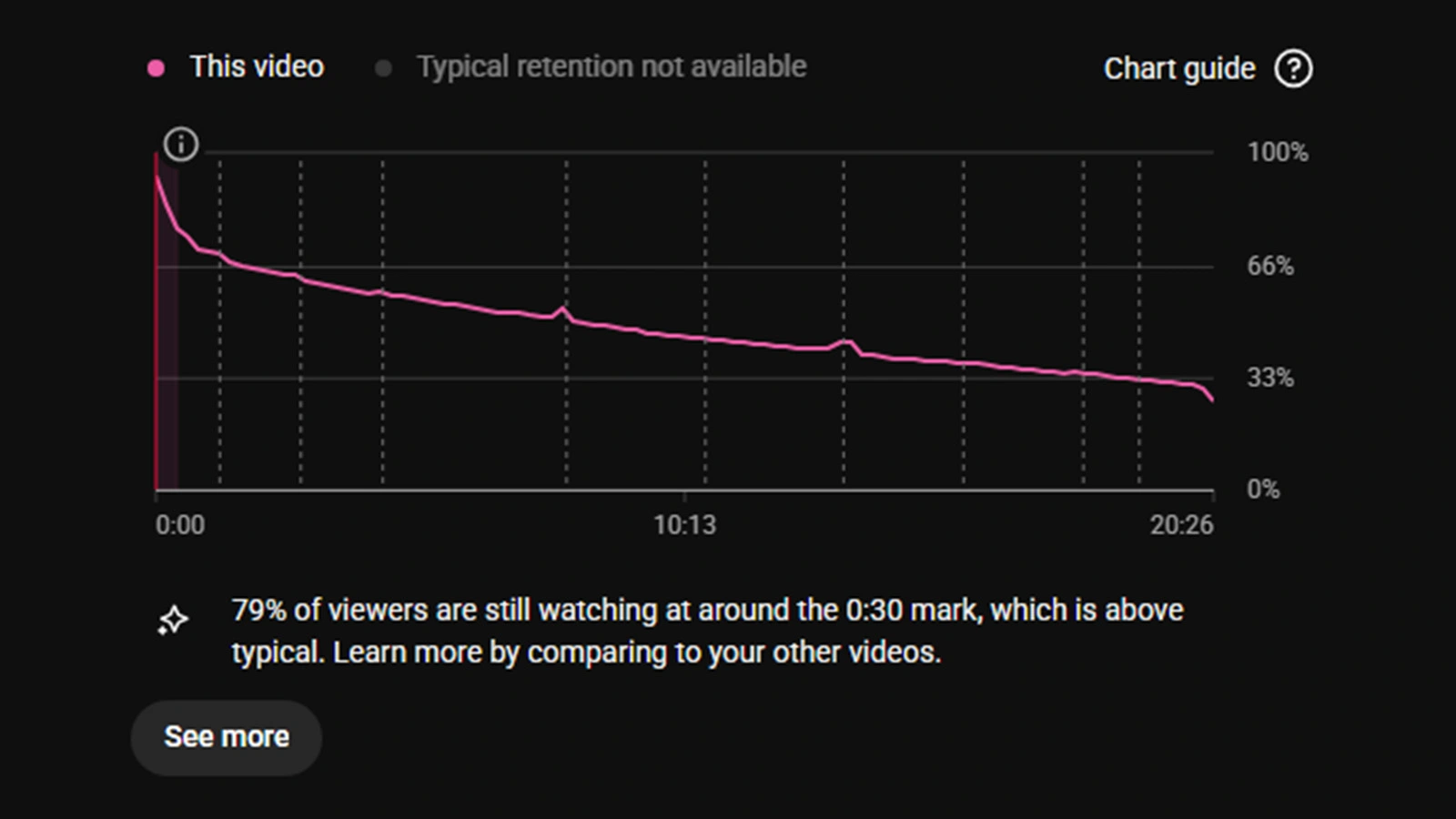
Average view duration is a summary. The retention graph tells the real story.
The first 30 seconds
The biggest drop on almost any YouTube video happens in the first 30 seconds. This is normal. Not everyone who clicks will stay, and some will realise within the first few moments that the video is not what they came for.
What is not normal is losing 80 or 90% of your audience before the half-minute mark. A drop of more than 30% in the first 30 seconds, meaning fewer than 70% of viewers are still watching after 30 seconds, points to a specific set of problems: a weak hook that does not earn the viewer's attention, a slow or padded opener that does not get to the point quickly enough, or a mismatch between what the title and thumbnail promised and what the video actually opens with.
Check this number specifically rather than relying on overall retention. A video can have a reasonable average view duration and still be losing far too many people in the first half-minute, which suppresses the performance of everything that follows.
Drops throughout the video
After the first 30 seconds, look for any points where the graph shows a drop of 2% or more within a short time span. A gradual decline throughout a video is expected and normal. Sharp, sudden drops at a specific timestamp are not.
Those drops mark moments where a meaningful number of viewers decided to stop watching at the same time. That is useful information. It could be a transition that feels jarring, a section that drags, a moment where the video feels like it has already ended but keeps going, or a topic shift that lost the audience.
The real value comes from finding patterns across multiple videos rather than diagnosing any single one. If the same type of drop appears at a similar structural point in several videos, that is a repeatable issue in your format or pacing that is worth addressing directly.
What causes low retention and how to fix it
Hook problems (first 30 seconds)
If you are losing more than 30% of viewers in the first 30 seconds, the hook is the place to start.
A strong hook does one specific thing: it gives the viewer an immediate and compelling reason to keep watching. This could be a provocative statement, a question that the video will answer, a preview of what is coming, or a moment that immediately demonstrates the value of what follows. What it should not be is a slow introduction, a lengthy explanation of who you are, or a generic statement about the topic.
Review the opening 30 seconds of the videos where this drop is happening. Watch them as a viewer who has just clicked and wants to decide immediately whether to stay. If the video has not given that viewer a clear reason to stay within the first 15 to 20 seconds, that is the problem.
Mid-video drops
For drops occurring after the 30-second mark, watch the video from slightly before the timestamp where the drop begins. Often the cause is obvious: a topic shift that feels like the video is starting again, a section that adds length without adding value, or a moment where the pacing slows significantly.
The fix varies by cause, but the diagnosis process is always the same: find the moment, watch it, and ask whether a viewer who was engaged up to that point would choose to keep watching after it.
Low overall retention
If the average view duration is low across the whole video rather than at one specific point, the structure of the content itself is usually the issue. The video may be covering too much ground without going deep enough on any of it, the pacing may be inconsistent throughout, or the topic may not have enough substance to sustain the intended length.
Shortening the video is sometimes the right fix. A 12-minute video with enough content for 8 minutes will hold viewers better at 8 minutes than at 12.
Find out what is holding your YouTube channel back
Run the free Crescivo Bottleneck Calculator to identify whether retention is your main issue or whether something else is limiting your growth first.
Get Started FreeFAQ
What is a good YouTube retention rate?+
For most content, holding 30% average view duration is a practical starting point. On a 10-minute video that means at least 3 minutes of average watch time. For videos over 60 minutes, aim for at least 5 minutes as a minimum floor. Higher is always better, and these figures are starting baselines rather than targets to stop at.
What percentage of viewers should still be watching after 30 seconds?+
At least 70%. A drop of more than 30% in the first 30 seconds is a signal that the hook is weak, the opener is too slow, or the video is not delivering on what the title and thumbnail promised. The first 30 seconds are the highest-risk part of any video and deserve the most attention.
When should I start looking at my YouTube retention rate?+
Once you have at least 10,000 impressions on a video and a meaningful number of views. Retention on videos with very low view counts fluctuates too much to be reliable. Fix impressions and CTR first. When you have enough views for the average to be representative, then retention data becomes worth acting on.
Why does my YouTube retention drop at a specific point in the video?+
Sharp drops at a specific timestamp usually mark a moment where a significant number of viewers decided to stop at the same time. Common causes are a topic shift that feels jarring, a section that drags, a moment where the video feels like it has ended but continues, or a pacing drop. Watch the video from slightly before the drop point and look for what changes at that moment.
How do I improve YouTube retention?+
Work on the specific problem the graph is showing. Drops in the first 30 seconds point to a weak hook or slow opener. Sharp drops mid-video point to a specific moment worth reviewing. Low retention across the whole video usually points to a structural or pacing issue. Find patterns across multiple videos rather than over-diagnosing any single one.
Does YouTube retention affect how the algorithm distributes videos?+
Yes. Retention is one of the signals YouTube uses to understand whether a video is delivering what viewers came for. Strong retention tells YouTube the content is worth recommending to more people. Low retention, especially early drop-offs, tells it the opposite. Improving retention helps both the viewer experience and the algorithm's willingness to push the video further.
What to do next
Open YouTube Studio and check the retention graph on your two or three most recent videos that have reached a meaningful view count. Look at the 30-second mark first, then scan for sharp drops after that. Find one pattern that appears across more than one video and address that in your next upload.
Find Your Biggest YouTube Bottleneck
Most creators guess what to fix. Run the free Channel Bottleneck Calculator and discover the one metric holding back your growth.
Run Free AnalysisRelated Articles
More guides to help you diagnose and improve your YouTube growth.
YouTube Analytics
How to Audit a YouTube Channel in 15 Minutes
You do not need hours to know if your YouTube channel has a problem. Here is a focused 15-minute audit that tells you exactly where to look and what the numbers mean.
YouTube Strategy
The YouTube Description Template That Ranks and Converts
Most YouTube descriptions are either ignored or stuffed with keywords. Here is the template that helps your videos rank on search and turn viewers into leads or subscribers.
YouTube Strategy
YouTube for B2B: How Businesses Use the Platform to Generate Leads
B2B businesses do not need millions of views to get results from YouTube. Here is how the platform builds trust, drives leads, and keeps you top of mind with buyers.
Find Your Biggest YouTube Bottleneck
Most creators guess what to fix. Run the free Channel Bottleneck Calculator and discover the one metric holding back your growth.
Run Free Analysis