YouTube Strategy
How Often Should You Post on YouTube?
There is no magic number for YouTube posting frequency. Here is the framework that actually determines how often you should upload.
By Crescivo Team • July 13, 2026 • 6 min read
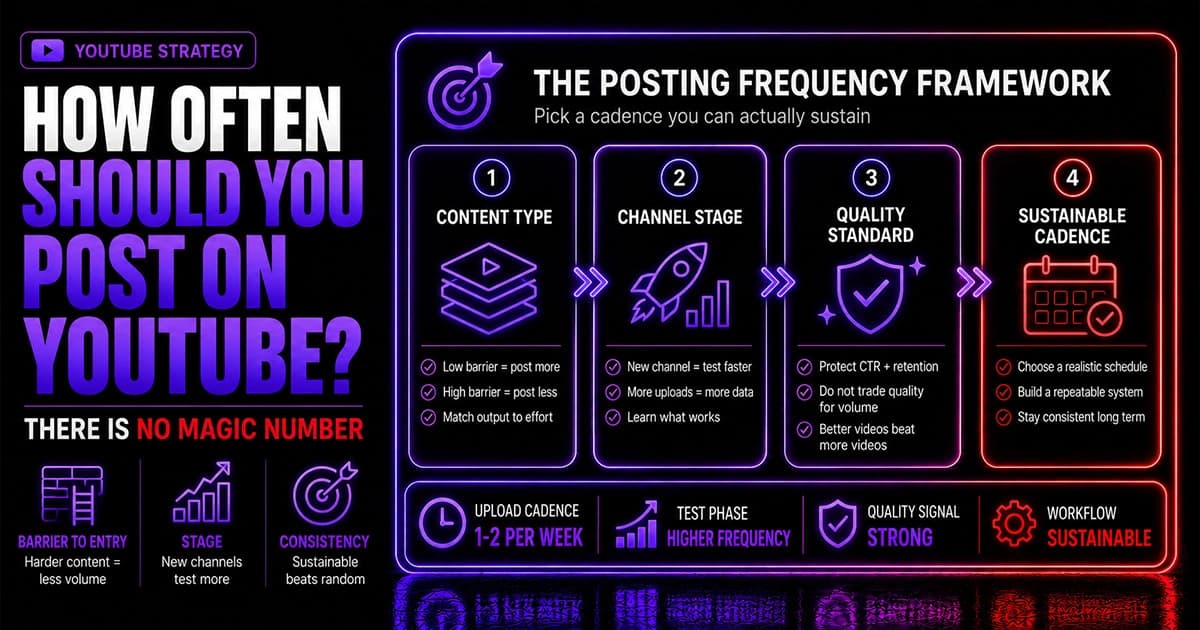
Table of contents
The question of how often to post on YouTube comes up constantly, and the honest answer is that there is no single right number. Anyone who gives you a fixed figure like "post three times a week" is leaving out the variables that actually matter.
Posting frequency depends on what type of content you are making, where you are in your channel's growth, and what you can sustain without quality dropping.
Find Your Biggest YouTube Bottleneck
Most creators guess what to fix. Run the free Channel Bottleneck Calculator and discover the one metric holding back your growth.
Run Free AnalysisThe variable that actually determines YouTube posting frequency
The most useful way to think about this is through the lens of barrier to entry: how hard is it for someone else to create the same type of content you are making?
If the barrier is low, volume matters more. News content is the clearest example. Gaming news, finance news, celebrity news, political commentary — all of it is easy to produce because anyone can report on something that already happened. Look at any major news channel and you will see dozens of videos posted every day. That is not an accident. In a low-barrier space, volume is the only real competitive advantage.
If the barrier is high, you can afford to post less. A high barrier does not just mean expensive production. It includes expertise. If you have been in an industry for 30 or 40 years, the barrier to entry for your content is high even if you are filming a simple talking head video. That experience cannot be easily replicated, and it makes each video worth more to the right viewer.
Documentary-style content works the same way. A documentary might take weeks or months to produce, but it can hold attention in a way a quickly made news clip never will. At that level, posting once a month or even less is completely justified.
When to post more on YouTube, regardless of niche
There are two situations where higher frequency makes sense no matter what kind of content you are creating.
Starting a new channel
A new channel has no data. You do not know what topics your audience will click on, how long they will watch, what thumbnails will perform, or what video length fits your content best.
Posting frequently early on is how you get that data quickly. Once you have it, you can slow down and focus on the formats and topics that actually performed rather than guessing. At this stage, the goal is not views. The goal is information so you can then cut what does not work and double down on what does.
Learning the craft
If you are new to YouTube and do not yet know how to edit, create thumbnails, script, or record, higher frequency is how you improve faster. Skills develop through repetition, and there is no shortcut to that.
Editing, scripting, recording, all of it gets better when you are doing it regularly rather than once every few weeks. The reps are the thing.
What your posting frequency cannot fix
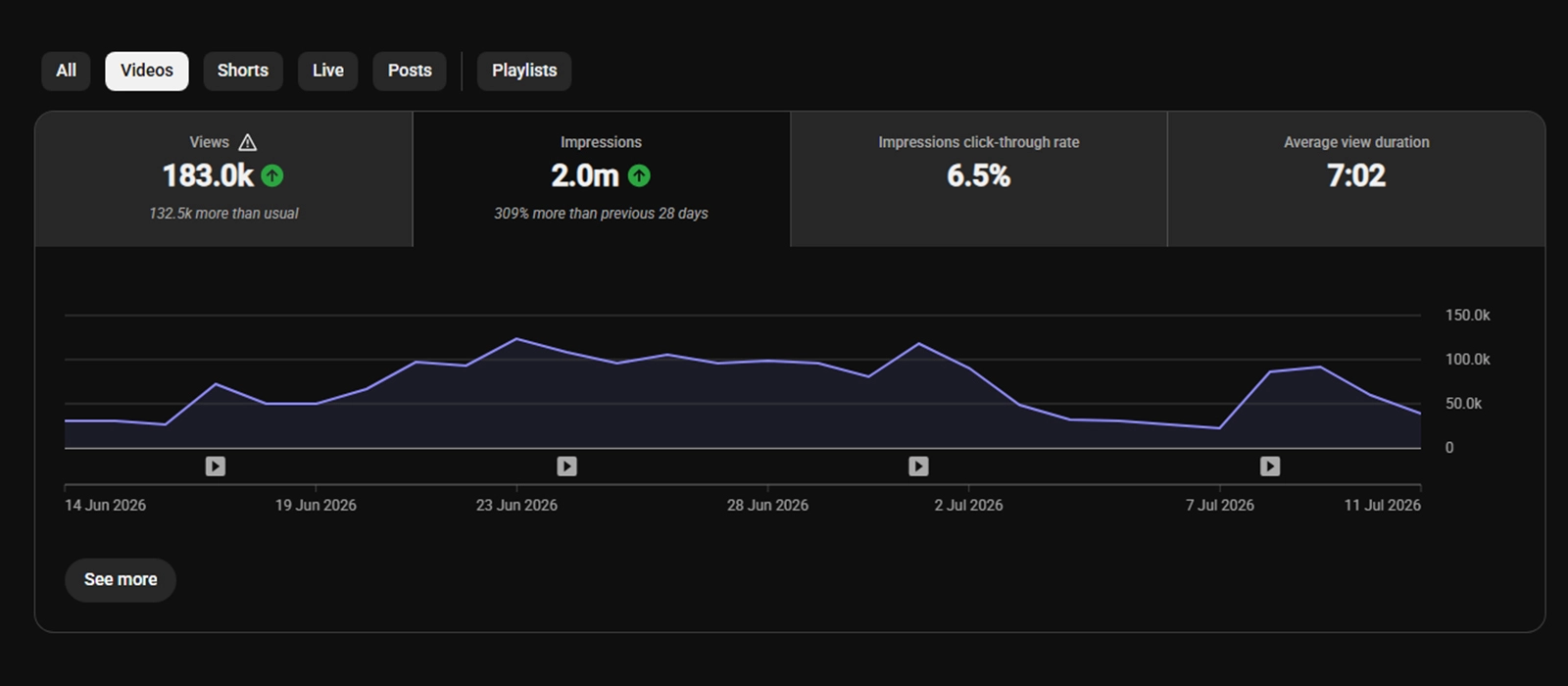
A higher upload schedule does not fix weak content. YouTube rewards videos that generate strong impressions, good CTR, solid retention, and clear signals that viewers found what they were looking for. Posting more low-quality content does not improve any of those numbers.
Before changing how often you post, it is worth knowing which metric is actually holding your channel back. If impressions are low, posting twice as often will not help. If retention drops in the first 30 seconds, a different upload frequency will not change that either.
The personal side of the decision
Beyond strategy, your posting frequency has to fit your life. Two checks are worth running before committing to any schedule.
First, at what point does your quality drop? Every creator has a pace below which their work gets noticeably worse. Figure out where that line is for you, because posting more frequently than that point is counterproductive.
Second, is there a schedule that caves in your life if you try to maintain it? If hitting a weekly upload target means your work, your relationships, or your health suffer, that schedule will not last. A channel you post to consistently for two years will outperform one that went hard for three months and then stopped.
Find your YouTube bottleneck
Run the free Crescivo Bottleneck Calculator and find out exactly where your channel is losing momentum before changing your upload schedule.
Get Started FreeFAQ
How often should I post on YouTube to grow?+
It depends on your content type. Low-barrier content like news or commentary benefits from higher volume. High-expertise or high-effort content can grow with less frequent uploads. For new channels, posting more early on gives you data faster so you can improve and focus on what works.
Does posting every day help on YouTube?+
It can help if you are early in your channel and still developing your skills. Daily uploads give you more reps, and more reps mean you improve faster. Once you know what is working, slowing down and putting more into each video usually gets a better return.
Is there a minimum number of times to post on YouTube per week?+
No. There is no minimum that applies to every channel. What matters is that your uploads are consistent enough to keep your audience engaged and that each video can perform well on impressions, CTR, and retention. One strong video a week beats three weak ones.
What happens if I post too infrequently on YouTube?+
In a low-barrier niche, infrequent posting makes it very hard to compete. In higher-barrier niches, gaps between uploads matter less. The bigger risk is losing consistency entirely. An inconsistent schedule is harder to recover from than a slow but steady one.
Does YouTube reward channels that post more often?+
YouTube does not directly reward frequency. It rewards videos that generate strong impressions, good CTR, solid retention, and viewer satisfaction. Posting more helps only if each video can hit those marks. Posting more low-quality content does not improve them.
How do I know if my posting frequency is right?+
Check your channel data. If you are getting impressions but a weak CTR, your packaging is the problem, not your frequency. If your retention drops early, your content needs work. Identify the bottleneck first, then decide whether changing your upload schedule is the right move.
What to do next
Decide your posting cadence based on your content type and where you are in your channel's journey, then use your analytics to track whether it is working.
Find Your Biggest YouTube Bottleneck
Most creators guess what to fix. Run the free Channel Bottleneck Calculator and discover the one metric holding back your growth.
Run Free AnalysisRelated Articles
More guides to help you diagnose and improve your YouTube growth.

YouTube Strategy
YouTube for B2B: How Businesses Use the Platform to Generate Leads
B2B businesses do not need millions of views to get results from YouTube. Here is how the platform builds trust, drives leads, and keeps you top of mind with buyers.

YouTube Strategy
How to Turn One YouTube Video Into Content for Every Platform
YouTube is the hardest platform to create for, but it gives you the most leverage. Here is how to repurpose one YouTube video into content across every other platform.

YouTube Strategy
How to Batch Record YouTube Videos (And Stay Weeks Ahead)
Batch recording YouTube videos is not just about saving time. It is about removing the weekly grind. Here is the production system that keeps you consistently ahead.
Find Your Biggest YouTube Bottleneck
Most creators guess what to fix. Run the free Channel Bottleneck Calculator and discover the one metric holding back your growth.
Run Free Analysis